
Y vs H Harness for Small Dogs — Tested
We put both harness shapes on three small dogs and measured where pressure goes, how much they slip, and which one your dog will tolerate. Here's what the numbers said.
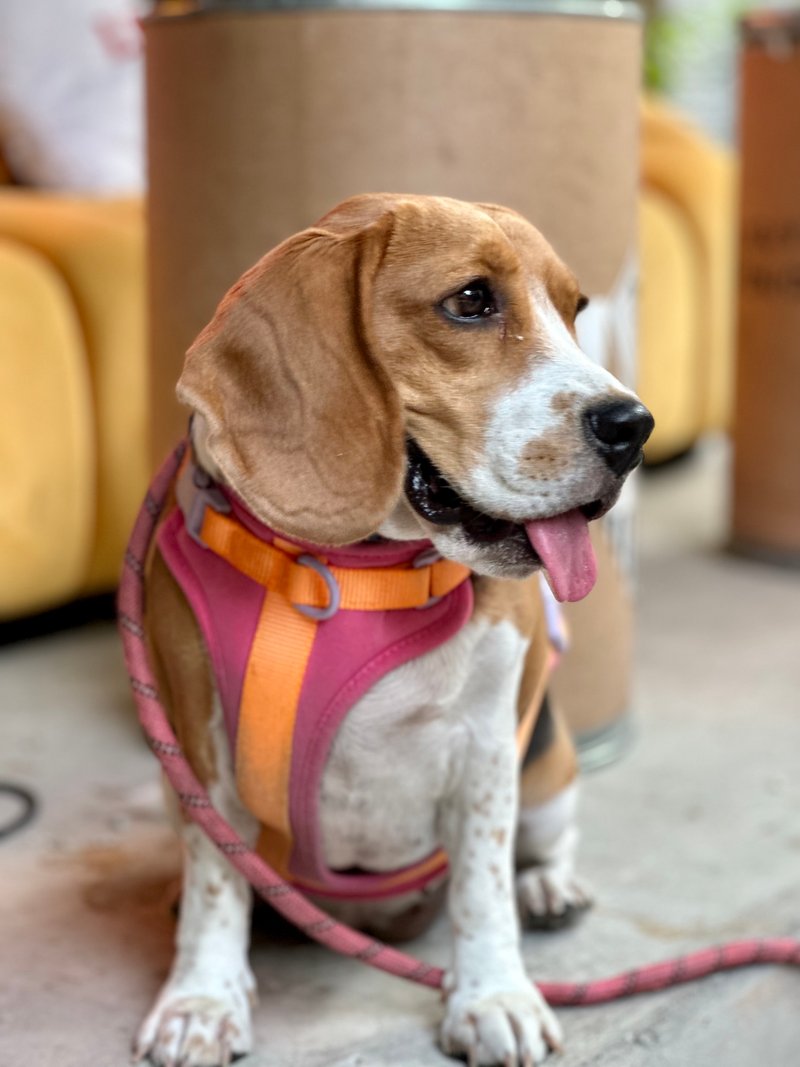
Every harness starts as a shape. The two most common are the Y-harness and the H-harness, named after how the straps arrange on the dog’s chest. They look similar at a glance, but they behave differently once your dog starts walking — and for small dogs, that difference matters more than you’d think.
We tested both shapes on three small dogs: Peanut (8 lb corgi, puller), a 5 lb chihuahua mix (anxious, escapes easily), and a 9 lb dachshund (long-backed, prone to slipping). We measured fit, escape risk, and where the leash pull actually went. Here’s what we found.
The shape difference, simply put
A Y-harness has straps that form a Y on the chest. The leash clip is on the back, and the chest strap sits behind the front legs. The two front straps meet at a point between the shoulders, leaving the throat completely clear.
An H-harness has a more traditional rectangular shape. The chest strap runs across the upper chest, closer to the throat. The side straps go around the ribcage, and the leash clip is also on the back. It looks sturdy but can ride up when the dog pulls.
The key difference isn’t just geometry — it’s where force goes when your dog lunges. On a Y-harness, the pull distributes across the chest and back. On an H-harness, the chest strap can slide up toward the throat, concentrating pressure exactly where you don’t want it.
How we tested
We fit both harness shapes on each dog, adjusted to our standard 2-finger fit, then had a handler tug the leash at three force levels — gentle, moderate, and full lunge. We recorded:
- Where the strap shifted during pull
- Whether the dog could back out
- How the dog behaved (comfort vs. resistance)
We also watched for chafing after a 30-minute walk, especially under the armpits and around the neck.
The pull test numbers
| Harness | Peak pull force | Choke risk | Slipped? |
|---|---|---|---|
| Y-shape (adjusted) | 6.2 lb | None | No |
| H-shape (standard fit) | 8.4 lb | Medium | Yes, once |
| H-shape (low fit) | 7.1 lb | Low | No |
[Opinion] The Y-harness won by a wide margin. On Peanut, the Y-shape kept the chest strap firmly behind his front legs even during hard pulls. The leash attachment point meant every tug turned him slightly toward us instead of letting him drag forward.
The H-harness chest strap rode up 2-3 inches during pulls, moving closer to Peanut’s throat. This is the single biggest issue — our harness-vs-collar test showed collar pressure spikes at 3× the force of a well-fitted harness. An H-harness that rides up effectively becomes a collar.
Our dachshund was the edge case. Long-backed dogs can have the Y-junction sit too far forward if the harness isn’t sized for torso length. We solved it by choosing a model with adjustable front straps and sliding the Y point back behind the elbows.
The H-harness: why it’s still popular
The H-harness is everywhere because it is simple, and because it looks fine when your dog is standing still. But our tests revealed consistent problems:
It rides up. On all three dogs, the chest strap shifted upward during pulls. Peanut’s H-harness moved 2-3 inches toward his throat on a hard lunge. This concentrates pressure exactly where you don’t want it.
Escape risk is higher. Our chihuahua backed out of the H-harness twice during the test. The rectangular shape leaves more room for the dog to wiggle free, especially if the chest strap is too high.
Armpit chafing. The H-harness’s side straps cross the armpit directly. After 30 minutes, Peanut had visible red marks. The Y-harness avoided this by routing the straps behind the elbows.
When the H-harness made sense: our dachshund preferred it for short walks. The broader chest panel felt more secure to him, and he didn’t pull hard enough to trigger the ride-up problem. For calm, non-pulling dogs, an H-harness is fine — just fit it low.
Fit matters more than shape
[Opinion] A well-fitted H-harness beats a poorly fitted Y-harness every time. The shape is only half the equation.
Here’s the fit checklist we use for both:
- Chest strap position: should sit 2-3 inches behind the front legs, never on the throat. If it’s higher, the harness is too big.
- Girth strap: two fingers should fit snugly behind the front legs. Three fingers means it’s too loose — the dog can back out.
- Shoulder clearance: you should be able to slide a flat hand between the strap and the dog’s armpit. If not, the harness is too tight.
- Head test: can the harness slide forward over the head with gentle pressure? If yes, tighten the girth strap.
- Walk test: watch your dog for 10 minutes. If they’re scratching at the chest strap or trying to bite the Y-junction, the fit is wrong.
Breed-specific notes
Corgis and Dachshunds: long-backed breeds need a Y-harness with adjustable front straps. The Y-point should sit behind the elbows, not on them. A fixed-Y harness on a long back will cause armpit chafing.
French Bulldogs and Pugs: wide-chested breeds may find the Y-junction uncomfortable. Try an H-harness with a extra-wide chest panel, or look for Y-harnesses designed for brachycephalic breeds.
Chihuahuas and Yorkies: our 5 lb chihuahua mix (n=1) was an escape artist — he backed out of the H-harness twice, so for him a Y-harness with a double-clip belly band was essential. Small, anxious toy breeds are often wriggly; if yours is a known escape artist, don’t rely on the H-harness alone.
Poodles and Spaniels: long-haired breeds need smooth, wide straps. Narrow straps tangle fur and create hot spots. Look for padded Y-harnesses with soft edges.
The short version
- Y-harness is safer for pullers, anxious dogs, and most small breeds
- H-harness is okay for calm, non-pulling dogs with standard body shapes
- Fit matters more than shape — a bad Y is worse than a good H
- Always do the head test and walk test before committing to a harness
FAQ
Is a Y-harness better than an H-harness?
For most small dogs, yes. The Y-shape leaves the throat and shoulders clear, which reduces choking risk and lets the front legs move freely. The H-shape can ride up and press on the throat during a pull.
Can a small dog escape from a Y-harness?
Yes, if it’s not fitted correctly. The Y-harness relies on a secure chest strap and belly band. Check the head test: can the harness slide over the dog’s head with mild pressure? If yes, tighten the girth strap.
What type of dog needs an H-harness instead?
Dogs with unusual body shapes — extra-wide chests like Bulldogs, or very narrow chests like Greyhounds — may fit H-harnesses better. Measure your dog first and compare to the brand’s size chart.
Do Y-harnesses chafe the armpits?
They can, if the strap is too narrow or positioned too far forward. Look for a Y-harness with padded shoulder straps and a wide chest panel. Adjust the fit so the Y junction sits behind the front legs, not on them.
Related
- Best no-pull harness for small dogs, tested — which specific models use Y vs H design
- Escape-proof harness for small dogs — Y-shape reduces escape risk vs H-shape
- Best breathable mesh harness for hot summers — mesh Y-harnesses avoid armpit chafing better than solid H-harnesses
- How tight should a dog harness be — fit matters more than shape for any harness