
How Tight Should a Dog Harness Be? 2-Finger Rule
We measured a dozen harnesses on three small dogs and found the 2-finger rule gets repeated wrong more often than right. Here's the exact procedure we use and the mistakes we see most.
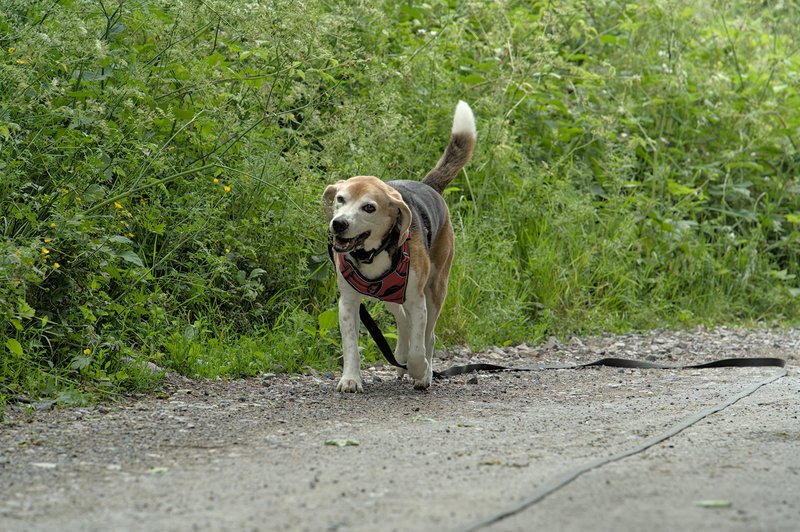
We fit harnesses for a living, and the “2-finger rule” gets mangled more than any other piece of sizing advice. It’s not that the rule is wrong —it’s that most people apply it to the wrong strap, on the wrong dog, and never re-check. We put a dozen harnesses through our fitting routine on three dogs of very different body types to pin down what actually works.
Why “two fingers” keeps getting repeated wrong
The 2-finger rule means: you should be able to slide two fingers under the harness with moderate resistance —not easily, not painfully. Most people test it on the chest strap, which is the wrong place, because the chest strap is the one that needs to be firmest. Test it on the girth strap behind the front legs instead.
Here’s the full routine we use on every dog before a walk:
- Put the harness on with the chest strap loose —just tight enough to stay in place.
- Tighten the girth strap first. Slide two fingers under it at the narrowest point behind the front legs. Two fingers should go in with resistance; three fingers means it’s too loose.
- Now tighten the chest strap so it sits high on the chest, above the point of the breastbone —never resting on the throat. One finger should fit here, not two.
- Check the front-leg clearance: you should be able to get a pinky under the strap where it crosses the armpit. If the strap touches the armpit fabric, it will chafe on long walks.
- Lift test: grab the handle (if the harness has one) and lift. The harness should stay put. If it rides up and twists, tighten the girth strap.
- Head test: can the harness slip forward over the dog’s head with mild pressure? If yes, it’s too loose —that’s exactly how small dogs back out of harnesses.
Where owners most often get it wrong
We cataloged the mistakes from our own fitting sessions:
- Testing on the chest strap, not the girth. The girth strap is what keeps the harness on. Tighten it first, then fine-tune the chest.
- Forgetting the dog moves. A dog sits, stands, jumps, and rolls. A fit that’s snug standing can be loose when the dog curls up to sleep. Check after play, not just before a walk.
- Confusing “snug” with “looks right.” A harness that looks perfect in the mirror can be several notches too loose. The fingers don’t lie.
- Never re-checking. Cloth straps relax. We re-fit every dog we see after their first month, and we’ve never once tightened nothing.
Fit is different for flat-chested breeds
A French Bulldog, a Pug, or a Boston Terrier have very different chest geometry from a Corgi or a Dachshund. On flat-chested dogs the chest strap can sit oddly low or dig in, and the girth strap has more room to shift. The fix is the same test, just applied more carefully:
- For flat-chested dogs, the chest strap should sit high enough that you can see it from the front when the dog is facing you. If it disappears under the chest, it’s riding on the throat —bad.
- For long-backed dogs (Corgi, Dachshund), the girth strap needs a notch tighter, because a long torso lets the harness slide backward toward the hind legs.
- For round-bodied dogs (puppies, Chihuahuas), watch the armpit clearance the most —a round ribcage pulls the straps in tighter than you’d expect.
The real danger of a loose harness
The most common small-dog harness injury we hear about isn’t a chafe —it’s a dog backing out and running into traffic. A harness loose enough to slide over the head defeats the entire point of wearing one. If your dog has ever slipped out, check the head test first.
At the other extreme, a harness that’s too tight on a small dog presses on the trachea. For breeds prone to collapsed trachea (Yorkshire Terriers, Chihuahuas, Poodles), the chest strap should be firm but never pressing on the throat —one finger, not two.
FAQ
How tight should a dog harness be?
Tight enough that two fingers fit snugly under the girth strap with moderate resistance, one finger under the chest strap, and the harness can’t slide over the dog’s head on its own.
Is a loose dog harness dangerous?
Yes —a harness loose enough to slip over the head lets a dog back out of it, and a loose girth strap rubs the armpits and chafes during a walk.
Can a harness be too tight on a dog?
Yes. A too-tight harness presses on the trachea, restricts breathing, and compresses the shoulder joint. Breeds prone to collapsed trachea are especially sensitive to throat pressure.
Do harnesses stretch over time?
Yes. Re-check the fit after the first month and after every wash —a harness that fit at purchase will almost always need a notch tighter.
Related
- Best no-pull harness for small dogs, tested —how a well-fitted harness behaves under real pulling force
- Y vs H harness for small dogs — strap position matters more than shape for any harness
- Escape-proof harness for small dogs — the same fit checklist prevents escapes
- Best breathable mesh harness for hot summers — a properly fitted mesh harness won’t ride up in heat
- Small dog gear sizing guide —measure your dog’s chest and back before you buy
- Backpack vs sling carrier: which is safer —the same fit logic applied to carriers